27 September 2011

CALL FOR PAPERS: What′s cooking? Food and eating at home

The Histories of Home Subject Specialist Network (SSN) is inviting papers for the Fourth Annual SSN Conference 'What`s cooking? Food and eating at home' to be held at the Brunei Gallery, School of Oriental and African Studies (SOAS) in London on Friday 9 March 2012.

There has been growing academic interest in the study of food, cooking and culinary history since the early 1990s, from the production and exchange of food on a global scale to its preparation and consumption on an individual level. This conference will focus on food within the domestic setting by charting changes in foodspaces over time, examining the politics of foodwork and investigating patterns of food consumption at home. Given the wealth of material available on the themes of food, memory and diaspora, the conference will have a UK-based geographical focus, which may include migrant food journeys centred around UK experiences.


We invite proposals for 25 minute papers on the following themes:
Foodwork
- patterns and negotiation of foodwork at home
- food as a marker of continuity and change within family life
- the changing meanings of objects involved in preparing and serving meals
- gendered division of labour in foodwork
- transmission of culinary skills
Foodspaces
- changes in foodspaces over time and their influence on how and where people cook and eat
Food pathways / food journeys
- including kitchen gardens, box schemes, food parcels and recycling
Cooking and identity
- cooking as expression of self-identity
- food and socio-economic status
Sharing food
- family meals and "proper meals"
- everyday feeding and eating habits
- feasts and celebrations at home
- hospitality and home entertaining
- the role of ritual and religion in food practices
Food idea(l)s
- including household manuals, changing table manners, food norms, healthy diets and eating disorders, the relationship between practice and aspiration, food as moral choice
Representations of food activities at home
- blogging, advertising, film, government propaganda, TV `foodporn`

Building on the tradition of previous SSN events, the Conference programme will include historical and contemporary papers from a wide range of disciplines. We are equally keen to encourage submissions from:
- academics and researchers;
- museum professionals who care for, interpret and use kitchens/culinary collections within historic house museums;
- archivists responsible for cookery book and household manual collections, and
- experimental archaeologists investigating food and cooking

Proposals
Please submit proposals, including title, abstract (of 200-300 words) and a brief biographical statement (c.100 words) by Monday 14 November 2011 to:

Krisztina Lackoi, SSN Co-ordinator, klackoi@geffrye-museum.org.uk
The Geffrye Museum of the Home, Kingsland Road, London, E2 8EA
http://historiesofhomessn.wordpress.com/

Participants will be notified of acceptance by early December 2011.

26 September 2011

Seminar: ‘Conservation and Source Communities: Research, Objects and Treatments’

Wednesday November 16th, 2011
The Pitt Rivers Museum, University of Oxford

Join the ICON Ethnography Group for a seminar exploring the growing links between conservators and source communities both in the UK and abroad.

In acknowledgement of the role source communities play as stakeholders in the care of collections, and with cultural institutions pushing for wider access and education, conservators have increasingly been seeking consultation with these groups. This has given fresh insight into collections, and informed conservation treatments and interpretation.

The day will include talks on recent collaborative projects between conservators and communities through direct participation and consultation at a distance. Participants will also discuss ethical issues that arise through consultation, and the continuing development of links between source communities and cultural institutions over the years.

The seminar will be held at the Pitt Rivers Museum, which houses an outstanding collection of world artefacts and archaeology, and which has an ongoing programme of active engagement with source communities both in the UK and around the world.

Please go to the Ethnography Group page on the ICON website for registration forms and more information:
http://www.icon.org.uk/index.php?option=com_content&task=view&id=112&Itemid=

or Email:  ethnoreg2011@gmail.com


Student: £30

Regular: £45

Lunch will be provided

21 September 2011

RAI: Blast from the Past

In anticipation of the London 2012 Olympics and Paralympics, the Royal Anthropological Institute’s Education Outreach Programme is running an oral histories project called Blast from the Past. The aim of the project is to connect people around the world through material objects related to sports, games and play.

They are asking people to dig through their attics, family trunks and wardrobes to find objects (sport kits, souvenirs, photos, medals or magazines) that capture special memories related to sport, games and play. Send us a video of you speaking about your object or write a story and send us a photo!

Who can participate?
Anyone interested in anthropology, history and sport

How do I submit my story?
Send us a photo of your object with a description of max 100 words. Alternatively, send us a short video clip, max 1:30 sec.

Deadline for submission: 16th November 2011

Further details and submission forms can be found on our Discover Anthropology website

9 August 2011

UCL course: Introduction to Conservation

The Centre for Museums, Heritage and Material Culture Studies in collaboration with Heritage Without Borders (www.heritagewithoutborders.org) will run the short course 'Introduction to Conservation: Looking at Objects' on September 7 and 8.

For further details, see the Centre's website: http://www.mhm.ucl.ac.uk/training/introduction-to-conservation.php

'Devil Dancing' at the Powell Cotton Museum

A display of Sri Lankan ‘Devil Dancing’ Masks at the Powell Cotton Museum, Quex Park, Birchington, Kent CT7 0BH has led to a forthcoming visit by Sri Lankan dancers, and even the High Commissioner.

The collection of masks at the Museum was bought 100 years ago in 1911 at Stevens Auction House in Covent Garden London by our founder, Major Percy Powell Cotton.  At the time the masks were said to be better than the collection at the British Museum!

They have been used in gallery displays previously but have not been seen by visitors for quite a few years.  They are dramatic and colourful  and this year it was decided they warranted their own display.  They are proving very popular with our visitors and the associated childrens’ activities have made the gallery a busy place.

The Museum had a recent visit from a representative of the Sri Lankan Tourism Office in London, who was certainly very impressed by what he saw.

 As a result, on Sunday 14th August at 2 p.m., the Museum will be welcoming dancers and the Sri Lankan High Commissioner.  The dancers will perform classical and masked Sri Lankan dance and then ceremonially process to the Gallery to formally open the exhibition.  Local mayors and councillors will attend to greet the High Commissioner.  Sri Lankan tea will be served.

It all goes to prove you never know what will happen when you bring things out of a cupboard……

The exhibition will run until the end of October.
 
Hazel Basford
Archivist, The Powell Cotton Museum

American Folklore Society Ethnographic Thesaurus

The American Folklore Society Ethnographic Thesaurus (www.openfolklore.org/et/) is now available in a beta version on the Open Folklore (www.openfolklore.org/) portal, a collaborative effort of the Society, the Indiana University-Bloomington Libraries, and the Indiana University Digital Library Program.

The post-beta version, the American Folklore Society Ethnographic Thesaurus 2.0, will be available on that same URL on October 1, 2011.

The AFS Ethnographic Thesaurus is a searchable online vocabulary that can be used to improve access to information about folklore, ethnomusicology, cultural anthropology, and related fields. Supported by a generous grant from the Scholarly Communications Program of the Andrew W. Mellon Foundation, and early planning-grant funding from the National Endowment for the Humanities, the American Folklore Society developed the Thesaurus in cooperation with the American Folklife Center of the Library of Congress.

AFS Ethnographic Thesaurus Editorial Board
(all of the American Folklife Center, Library of Congress, Washington, DC)

Catherine Hiebert Kerst, Folklife Specialist/Archivist
Maggie Kruesi, Cataloger
Michael Taft, Head of the Archive

4 August 2011

Review: Le CERCO, Museon Arlatan at Arles, France

By Alison Petch

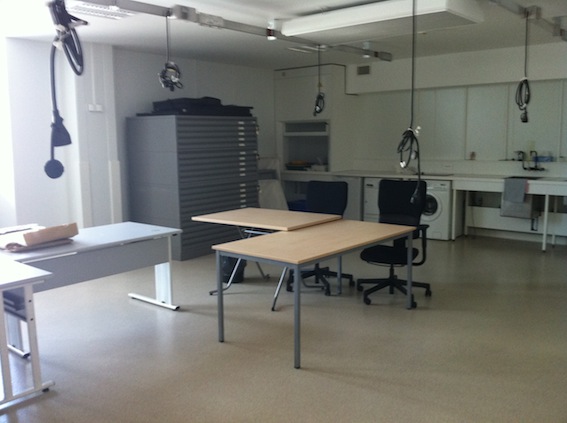
Members of MEG may remember the paper given at the 2008 conference by Dominique Serena-Allier and Véronique Dassié. Dominique is the Directeur et Conservateur en Chef du Patrimoine of the Museon Arlatan. She recently invited me to visit while in the region, when my friends and I were kindly guided round the newly completed museum stores by Sophie Peignen, one of the conservators. I thought readers of the blog might like to see some images I took during the visit of the pristine, and for now largely empty, new storage areas.

The Museon is based in the centre of Arles, in the Bouches-du-Rhone department, and includes displays of many of the day to day artefacts from the area surrounding Arles. The museum was founded by the poet Frédéric Mistral (1830-1914) who wanted to collect and display objects that explained the life and material culture of the “Provence rhodanienne”. The museum’s collections number more than 30,000 objects, including furniture, tools, clothing, textiles and archival and library materials.

The museum first opened in 1899 and Dominique was recently successful in attracting many millions of euros funding to develop the main museum site and to create a new storage, conservation and research centre a little outside the Arles town centre - Le CERCO (Le Centre d’Étude, de Restauration et de Conservation des Oeuvres). The main museum closed for renovation in 2009 and should reopen in 2014. The displays, as well as the fabric of the ancient building ( an eighteenth century Jesuit college) will be greatly changed.


Le CERCO was completed recently and work has begun on transferring collections to the new facilities. I was most impressed at the level of investment by the Conseil Général des Bouches-du-Rhône — it is a pity that the British state does not invest so deeply and wisely.


Le CERCO is based in an area with other local government facilities but has its own discrete area with 24-hour security and monitoring. Most circulation areas and all storage and treatment areas have full environmental control and air-conditioning. In addition all circulation areas (but not storage areas) have motion sensitive lighting. One of the few areas that is not air-conditioned is the staff rest room, where a respite from the ravages of air-conditioning on the human frame is more than welcome.


We were shown where new objects are frozen in a large conservation standard freezer, as well as treatment areas where objects can be treated to remove infestation. We also visited the conservation labs and storage areas. The storage areas for large objects (such as large items of furniture) include a fork-lift truck system to make retrieval much easier. We were also shown an area for visiting researchers.


I should like to thank Dominique and Sophie for enabling our visit to the centre and giving us such an excellent tour, and also thank Dominique for her permission to publish this account. Please note that the first image on this page was taken from flickr and the second and third images were taken from the Museon’s online information  about the development.